N3 Is The Most Important Sleep Stage for Muscle Growth

Not too long ago, I talked about the stages of sleep. I broke down the benefits of each stage, and I touched on some of the ways we can mess up those stages, and negatively impact our rest.
For a quick recap, there are 2 broad categories of sleep. REM, and Non-REM. Stages of non-REM are referred to as N1, N2, and N3. And then REM, which stands for Rapid Eye Movement, is just REM. Our bodies go through cycles of NREM - REM with REM progressively becoming a larger part of the cycle as the night progresses. Remember this for later, because it’s very important.
Today we will be focusing on N3 and how important it is for bodybuilding and really, all physical activity. If you’re trying to maximize muscle growth and recovery, this is the article for you.
Muscle Breakdown
So let’s say you are a bodybuilder, strength athlete, or a runner. Every time you engage in your sport, you're breaking your body down in some way or another. The muscle fibers are tearing apart, you’re putting strain on your joints, etc. Depending on the sport, this is what we want. Breaking down our muscles signals to our body that it needs to repair and rebuild things stronger than they originally were.
This is why it’s important to eat enough protein and be in a caloric surplus if you're trying to build muscle. Your body must have the supplies it needs to begin that rebuilding process. Think about adding a room to your house. If you hire the builders but don’t provide them with any materials, there isn’t much they can do. A calorie surplus represents the building materials in this metaphor. But we also need to give our bodies the time to rebuild and that happens when we sleep. It's not difficult to imagine, but think about what would happen if you didn't allow those builders any time to sleep. How much work could they actually get done?
Self Destructive Behavior
Our society has a love-hate relationship with sleep, and that can slow your progress. It seems like many of us are willing to do whatever we can to sleep less. We recognize the importance of eating and intense training, but if we can just stay on our phones a little bit longer, or wake up at 4 am because some billionaire claims that’s what he did? We’ll knock off a few hours of sleep with barely a second thought.
Maybe we think I can just drink a monster, or some coffee, or dry-scoop some pre-workout, and I’ll be good to go. But that’s not the truth. Missing out on N3 will do more than just have you feeling tired.

So what is N3?
This is a picture of what it looks like. It probably just looks like a bunch of squiggles to you.
And yeah, that’s what it is, a bunch of squiggles. These squiggles are tall, delta waves. These waves come from the frontal lobe, labeled F4 - M1. It makes up 15-20% of our sleep.
N3 is correlated with the secretion of growth hormone. The hormone production synchronizes with N3. Growth Hormone (GH) increases muscle mass, bone density, and a bunch of other things. In general, our production of GH declines once we become adults.
GH is among one of the many steroids that bodybuilders may end up taking. For those of us who want to stay natural, Instead of using steroids and dealing with all these side effects that can come from that, we should focus on giving our bodies the best environment possible for them to grow muscle. This will also help us avoid ever becoming too muscular in a way that can appear grotesque to some people.
Knowing that our bodies make less GH when we are older, and knowing that N3 is our primary “source” of the hormone, we need to focus on spending as much time in that stage as we can if we have a physical hobby like bodybuilding, or rock climbing that we want to excel at.
So how do we do that?
Avoid The Rebound
The number one thing you can do is make sure that you are not sleep-deprived. As we cycle through our stages, REM becomes more dominant, while NREM, including N3, starts to dial back. If you are sleep deprived, in most cases you're going to sacrifice a bit of REM sleep. This isn’t optimal to begin with, but maybe you're saying “Hey this article is about N3, the muscle growth phase. I don’t care about REM sleep!”
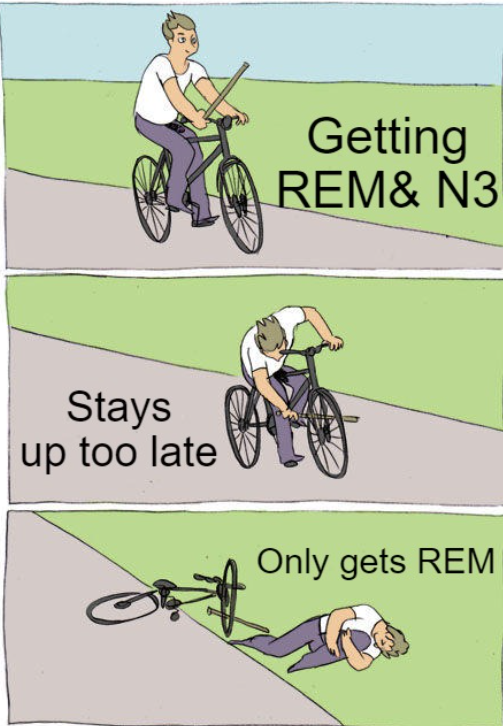
Well you should, because there is a thing called REM rebound, and it’s coming for your growth hormone. This is where, upon falling asleep, our bodies go into REM sleep as quickly as possible. If you’ve ever taken a nap, and immediately had a dream, you’ve probably experienced REM rebound. Our body is trying to make up for what it missed the night before.
Which makes sense, because REM sleep is awesome and has tons of benefits. But wouldn't it have been great if you got enough REM and N3? Because remember what we said at the start?
Early in the night NREM, including N3 makes up a good amount of our sleep cycle, and REM naturally makes up more of the sleep cycle as the night goes on. So now, if you're experiencing REM rebound, you're double dipping into REM, at the expense of N3. This isn’t to say you won’t get any GH, but we can confidently say that you’re getting less.
So the first thing you should do is keep an eye on how much sleep you're getting. On average, people need about 8 hours of sleep a night. I recommend starting from there, and maybe adding or removing an hour depending on how you feel. With 8 hours being the average, some people will need more sleep, some will need less. In my very personal opinion, I think anything under 7 hours is probably too little, and anything over 9 is just unnecessary, or a sign you were sleep deprived.
I’m suspect of people who say they are fine on 6 hours of sleep. If you’re one of those people, then take this with a grain of salt, but at least make sure you actually are thriving on 6 hours of sleep and not just surviving by using stimulants like caffeine to cope. Recognize that we are incentivized economically, psychologically, and socially to sleep less. It may be hard to admit that we need more sleep, but we can’t sleep longer without sacrificing something important to us. It’s ok if we prioritize our family, friends, or jobs over an extra hour of sleep, as long as we recognize the reality of the situation.
On the opposite end, if you need close to 10 hours of sleep, I’d also suggest reconsidering your sleep habits. Make sure you aren’t routinely sleep-deprived. If you are not sleep deprived, keep an eye out for symptoms of sleep disorders, like sleep apnea or restless leg syndrome. Perhaps your body is asking you to sleep longer in an attempt to make up for lower-quality sleep. But if everything checks out, and 10 hours is what you need, then hey, just make sure you get your 10 hours of sleep.
Keep It Cold
Our circadian rhythms are our body's schedule. According to Sleepfoundation.org, our body temperature starts to drop about 2 hours before we normally go to sleep. The temperature continues to fall until the early morning. Fighting your circadian rhythm can lead to all sorts of issues. So instead of fighting it, we could work with it by lowering the temperature a couple of hours before our bedtime. What temperature works best? I’d personally recommend 68 degrees. Once I began cooling my bedroom to this temperature, I started to sleep much better. So I’d suggest starting at 68 degrees and adjusting up or down based on if your sleep is improving or not, though I suggest you lean towards the colder side. A slightly too-warm bedroom will negatively impact your sleep more than a slightly too-cold bedroom will.
Be Consistent
As with most things, being consistent is the key to success. In this context, we must keep the same bedtime, as much as possible. If we are constantly switching up our bedtime, there will be times when we are fighting our circadian rhythm. Going to sleep at 2 am, multiple times this week will make it much harder to get sleepy at 10 pm. We’ve trained our rhythm to begin cooling down at midnight.
The good news is, that once you actually enter N3, it’s actually pretty hard to be woken up out of it. Being the deepest stage of sleep, and it's the hardest to wake up from. Still, it’s important to make sure that your bedroom is quiet, and that there is as little light pollution as possible. If needed, consider black-out curtains, and even earplugs so that way you can make sure you actually get into N3.
Combine all these tips, to improve your sleep quality, grow more muscle, and feel just a bit better.