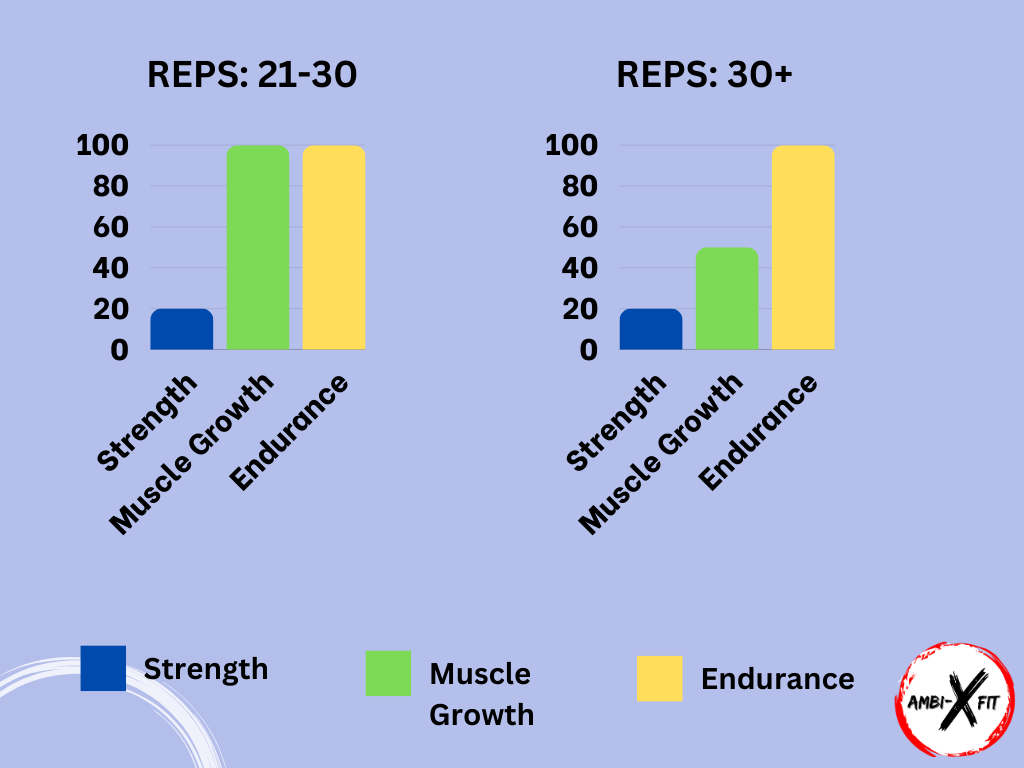
How Many Reps Should I Be Doing?
How many reps should I be doing? I get that question a lot, and the answer is actually pretty simple, though we will have to work our way through the dreaded “It depends” before we get there. First, let’s understand the S.A.I.D principle. Specific Adaptation to Imposed Demand.
This effectively means that your body will get good at doing the specific thing you train it to do.
To some degree, we can imagine different rep ranges as different types of training. So we have to pick the range that gives us what we want.
Training for Strength:

Strength is composed of two things:
1. The intensity with which our muscle fibers are recruited to move the weight.
2. The number of muscle fibers we’re able to recruit.
This means that we get strong by “teaching” the muscles to ramp up their intensity. And we also can get stronger, by increasing the cross-sectional area of the fibers that we are calling on. I.E get bigger muscles
In most cases, when we get stronger, we’re actually unlocking potential that already existed in our musculature. For a variety of reasons, this potential is locked away. By training in the “strength” rep range, we teach our body that we are “ready” for that strength and that it doesn’t need to be locked away.
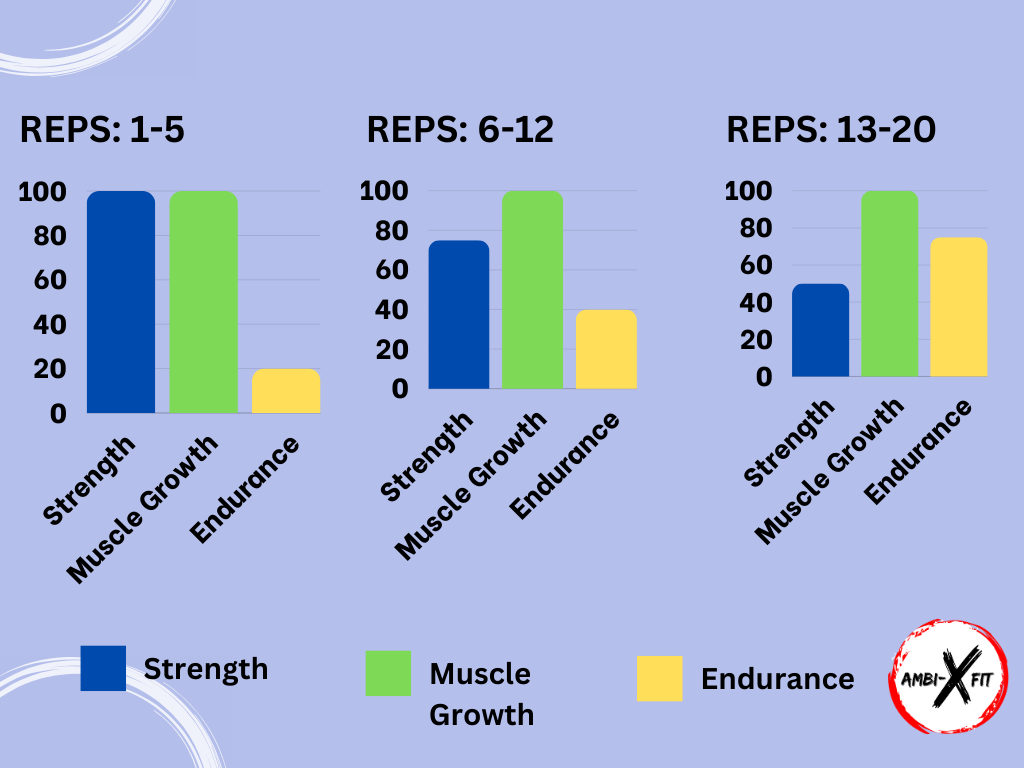
The strength rep range tends to look something like 1-5 reps. It’s important to understand that training past 5 reps will absolutely get you stronger. It’s just when you’re dealing with low reps, you tend to be moving the heaviest weight possible while still maintaining good form. Moving “moderately” heavy weights past the 5 rep range will get you stronger, just marginally slower. In most cases, I actually do not recommend training in this rep range.
Strength training also tends to require longer rest times and more sets. We tend to rest longer because we want to get the best training stimulus by pushing the heaviest weight. We want to make sure we’ve cleared out any intra-session fatigue before hitting the next set.
More sets are also used as a way to give us a solid dose of that heavy weight. Strength sets can range anywhere from 3-7.
It can look like:
4x5
5x5
6x3
7x2, and so on.
Training for Hypertrophy:

Muscle growth almost seems to be an outlier, at least according to current research. Research shows that muscle can be grown anywhere from 5-30 reps, and very likely can still be grown outside of that rep range.
“With respect to hypertrophy, the compelling body of literature indicates that similar whole muscle growth (i.e., muscle thickness, CSA) can be achieved across a wide spectrum of loading ranges ≥ ~30% 1RM. These findings are independent of age and training status. Thus, as a matter of principle, there is no ideal “hypertrophy zone.””
The primary factor seems to be proximity to muscular failure. I’ll talk about muscular failure in another article, but it seems like we can grow muscle if we are at least 4 reps away from true muscular failure.
So if we pick a weight that we can move 10 times, but absolutely, not 11 times– then we can grow muscle by moving that weight at least 6 times. I’m a firm believer that it’s much better to aim for a minimum of 7 reps, in this scenario, but that’s a topic for another time.
Now you may be thinking, “I can always train to failure in the 1-5 range and maximize muscle growth and strength!”
In theory, you could, but in practice, this is a horrible idea. There are a few problems that stop this from becoming practical.
The first is injury risk. Working in the 1-5 rep range, close to muscular failure puts you at a high risk of injury. The closer you get to muscle failure, the more likely your form is to break down. If your form breaks down, other muscles that you didn’t plan on targeting can come into play, or you can put yourself in precarious positions, which is not ideal when you’re moving heavy weights. There are only so many times you can do this before you take a visit to Snap City. Progress is not made in Snap City.
Next is fatigue. Even if everything goes perfectly, moving heavy weights will build up systemic fatigue. This will very quickly start to affect your performance and lead to a plateau. If you continue on, while ignoring the risk of injury, at some point your performance will degrade.
There are techniques that work great for pushing a muscle to failure, in ways that keep the intensity focused on the intended muscle, but these techniques almost always require you to lower the weight, or else the bar isn’t going to move.
However, there are ways to achieve both. Simply put, you can work in the middle rep range, with moderately heavy weights and reap solid benefits from both. In my opinion, anything past 3 reps is fine for both, BUT 6 Reps is the PERFECT minimum. The weight is likely light enough that form breakdown won’t cause injury, but the reps are still low enough that you’re training your body to move genuinely heavy weights.
Or you can periodize. We’ll talk more about that later, but that simply means that you focus on a specific thing at a specific time.
Hypertrophy rest times, in my opinion, can vary widely. I’ll just say this: Rest long enough so that your fatigue isn’t the limiting factor. And don’t rest so long that you’re dragging your training out.
For me, this tends to workout to a 2-4 minute rest period depending on the exercise and where I am in my training.
Training for Muscular Endurance:

Muscular endurance is best thought of as your ability to move a set weight as many times as possible. Think about how many push-ups you can do in a row. If you ever wanted to do 50 push-ups in a row, you wanted to improve your muscular endurance.
Building endurance involves a few different things, teaching your body to clear lactic acid efficiently, improving your glycolytic system, etc. The most common forms of endurance training are things like jogging, jumping rope, and rowing, things that train your cardiovascular system.
Training for muscular endurance has a place, though it’s not quite as popular as training for strength. It is arguable that endurance without strength isn’t as useful as strength without endurance. But this depends entirely on your goals.
If you care exclusively about muscular endurance, then you’ll probably want to identify your target rep number. Let’s stick with our example of 50 push ups, all done in one set.
First, let’s aim past our target. Let’s aim for 60 reps. Overshooting, paired with a unique form of double progression should help us improve our endurance.
What you’ll do is break those 60 reps down into multiple sets. So maybe you’ll do sets of 5x12, with 2 minutes of rest between sets.
You’re going to want to progress in two ways. First, start lowering your rest times between sets.
Knock those rest times down to somewhere around 30 seconds.
Next, you’ll want to start decreasing the sets, and increasing the reps done per set. At some point, your sets will become lopsided. Your first few sets will be on the high end, and your later sets will be lower. It may look like
Set 1: 25 reps
Set 2: 20 reps
Set 3: 15 reps.
You may have to increase rest times back up. This is fine. You’ll work your way back down to the minimum rest time, and then try to cut sets down, consolidate reps even more, even if it bumps your rest time back up. This can be repeated until you’re knocking out your actual goal of 50 pushups, in one set.